Separate levels of analysis.
Differences between people and changes within a person answer different questions. Treating them as interchangeable can flatten the process we are trying to explain.
About
I am a Clinical Psychology Ph.D. student at the University of Michigan studying personality pathology, self and interpersonal functioning, and the ways psychological patterns are expressed across relationships, contexts, and time.

My research is organized around a broad question: how do relatively enduring features of personality become expressed in the way people understand themselves, relate to others, and function in everyday life?
I draw on dimensional models of psychopathology, contemporary interpersonal theory, and psychodynamic and developmental approaches to personality. I am especially interested in what we learn when different levels or perspectives do not line up neatly: between-person structure versus within-person process, self-report versus informant perspective, or stable disposition versus context-sensitive behavior.
Across empirical research and public writing, I aim to develop models that are theoretically rich, methodologically rigorous, clinically interpretable, and attentive to the experiences of the people they are intended to describe.
Working principles
The design of a study should express the theory it is meant to test.
Differences between people and changes within a person answer different questions. Treating them as interchangeable can flatten the process we are trying to explain.
Personality pathology is expressed in relationships and embedded in broader social systems. Assessment should retain that context rather than subtract it away.
Quantitative sophistication matters when the design and analysis match the level at which the psychological phenomenon is supposed to exist.
Training
University of Michigan · Personality Processes and Outcomes Laboratory
Fordham University · Bronx Personality Lab · GPA 4.0
California State University, Los Angeles · Summa Cum Laude · GPA 4.0
Research in conversation
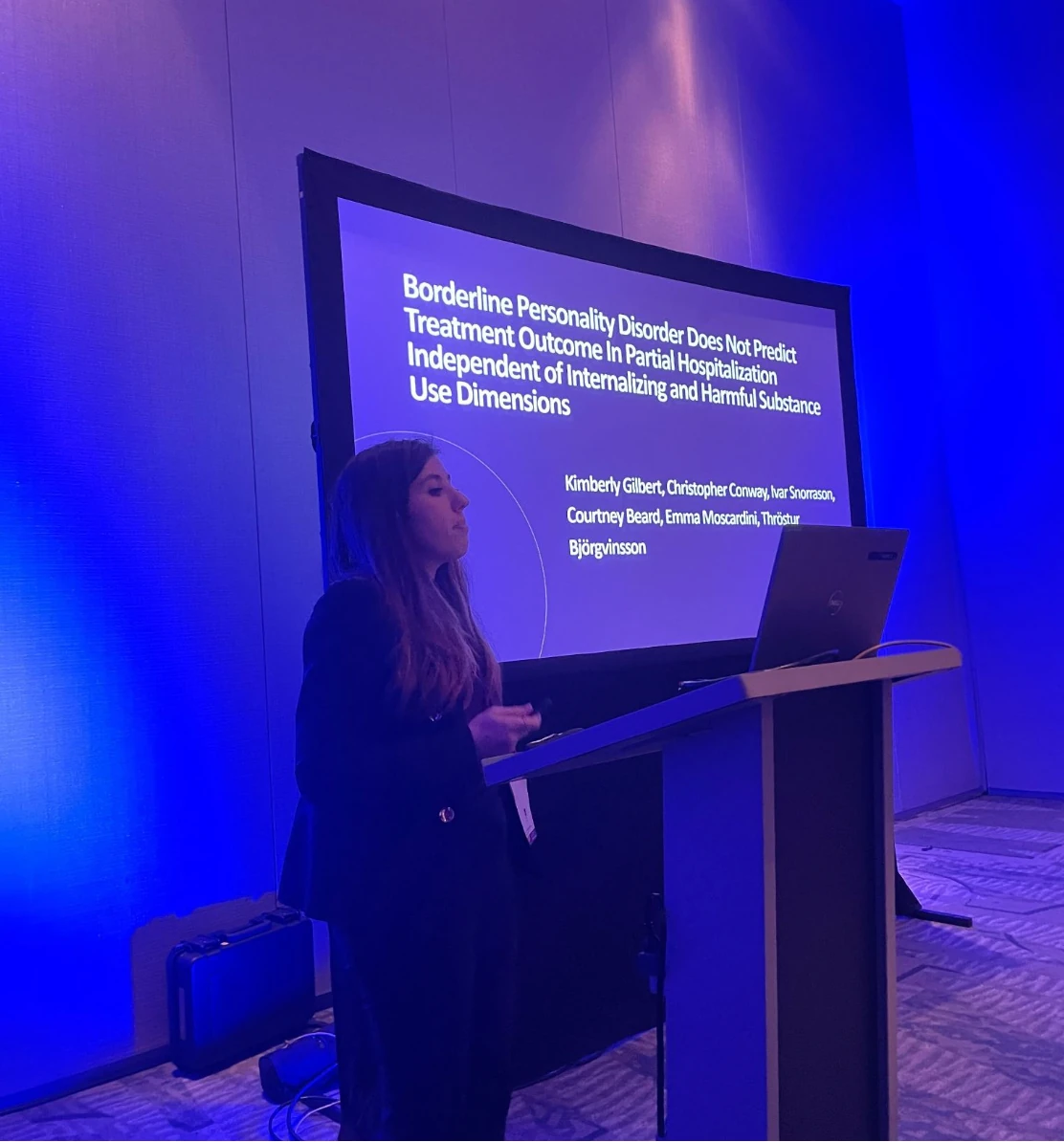
At the 2025 meeting of the International Society for the Study of Personality Disorders in Boston, I presented research on whether borderline personality disorder predicts treatment outcome in partial hospitalization once broader internalizing and harmful substance use dimensions are taken into account.
The findings suggested that after modeling these broader dimensions, the borderline diagnosis contributed very little unique prognostic information. The presentation opened a larger conversation about what diagnostic labels add, what dimensional models clarify, and how clinical prediction changes when we shift the level of analysis.
Read the published study overviewMethods
Recognition
University of Michigan, 2026
Approach
Connect