Clinical Psychology Ph.D. Student · University of Michigan
The science of personality in motion.
I study how personality pathology is organized within the self and in relationships, and how relatively enduring patterns become expressed differently across people, perspectives, situations, and time.
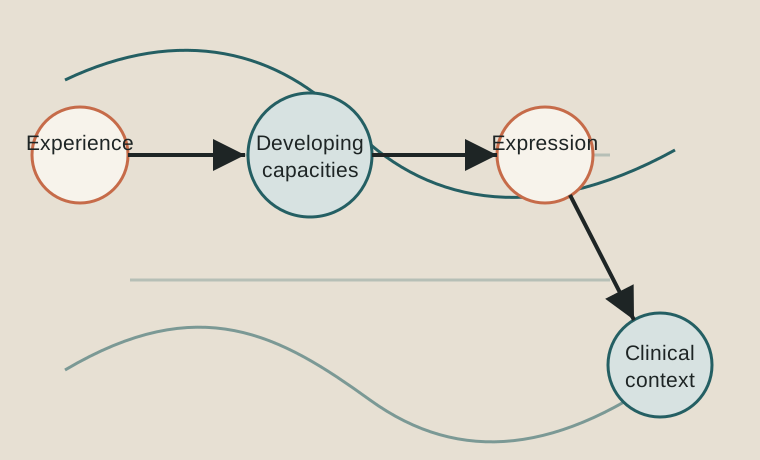
Personality has organization.Expression depends on context.Clinical meaning depends on both.
01
Self and relationships
02
Structure and process
03
Multiple perspectives
Selected published work
Different questions, one research program.
Selected articles that connect personality organization, interpersonal functioning, clinical theory, and quantitative methods.
Personality and Mental Health · 2026
Severity and style answer different clinical questions.
Personality functioning can be understood as a developmental capacity involving the organization of self and relationships, while traits describe the characteristic style through which difficulties are expressed.
Disagreement across interpersonal surfaces can itself be informative.
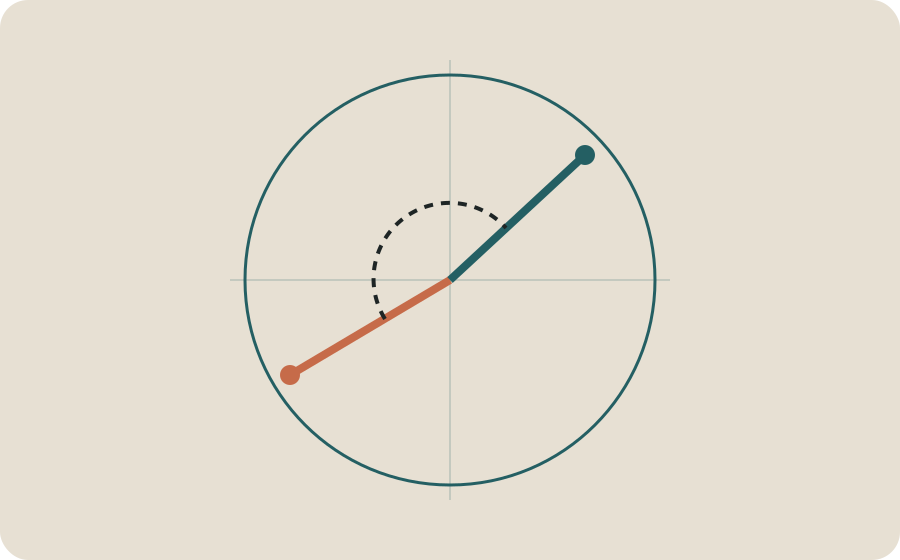
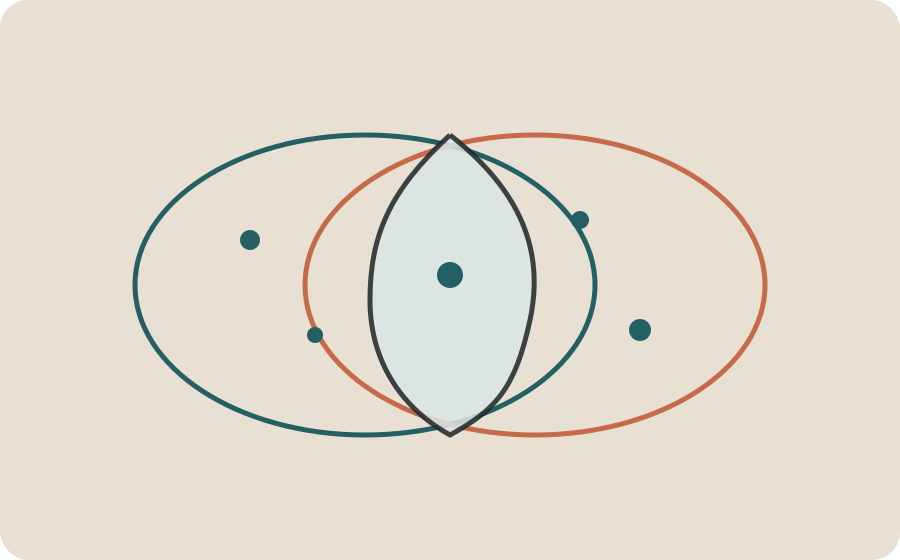
Differences between interpersonal problems, values, and perceived capabilities can contain information about personality functioning that is not reducible to the elevation of any one profile.
Dimensional models can preserve much of BPD while still leaving clinically important gaps.
Across three samples, AMPD dimensions captured substantial variation in borderline personality features, with less complete coverage of some interpersonal and self-destructive content.
Interpersonal geometry has consequences for study design.
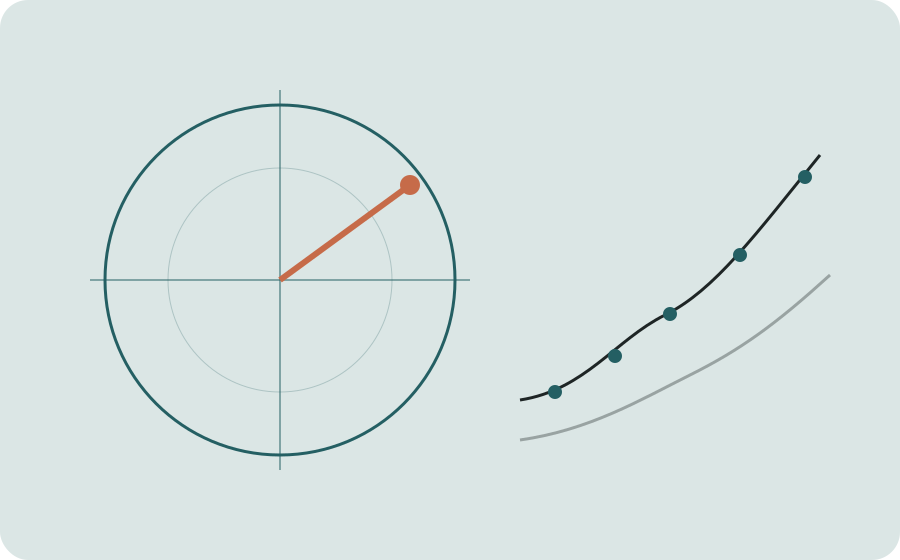
Prospective power for circumplex profiles depends on which parameter is being tested and, for angular displacement, on how strongly the underlying profile is differentiated.
How does the way people treat themselves fit within contemporary models of psychopathology?
The SASB introject provides a formal bridge between theories of internalization, the self-system, structural psychopathology, and daily interpersonal experience.
Identity, personality functioning, self-treatment, developmental severity, and the organization of psychological capacities.
Criterion A · Identity · Introject · Development
02 / Relationships
Relationships & Interpersonal Dynamics
Interpersonal problems, complementarity, informant perspectives, dyadic processes, and how people shape one another in interaction.
Circumplex · Complementarity · Informants · Dyads
03 / Context
Structure, Context & Process
When stable individual differences generalize across situations, when they do not, and what different timescales reveal about psychological organization.
Within-person · Between-person · Context · Time
04 / Clinical meaning
Diagnosis & Clinical Meaning
Dimensional nosology, diagnostic language, stigma, treatment relevance, and the role of lived experience in evaluating systems of personality disorder diagnosis.
I study how personality is organized within the self and in relationships, and how that organization is expressed across contexts and time.
I am a Clinical Psychology Ph.D. student at the University of Michigan. My work connects dimensional psychopathology with interpersonal, psychodynamic, and developmental theory, using methods suited to the level at which the psychological question is posed.