Published · Empirical Article
The DSM-5 Alternative Model of Personality Disorder's Coverage of Borderline Personality Concepts from the Clinical Literature
Plain-language finding
Across three samples, AMPD dimensions accounted for most variance in borderline personality features, while revealing uneven coverage of some clinically important domains.
Project overview
The study evaluates how well Criterion A and Criterion B encode longstanding clinical descriptions of borderline personality disorder across three independent samples.
Coverage and omission
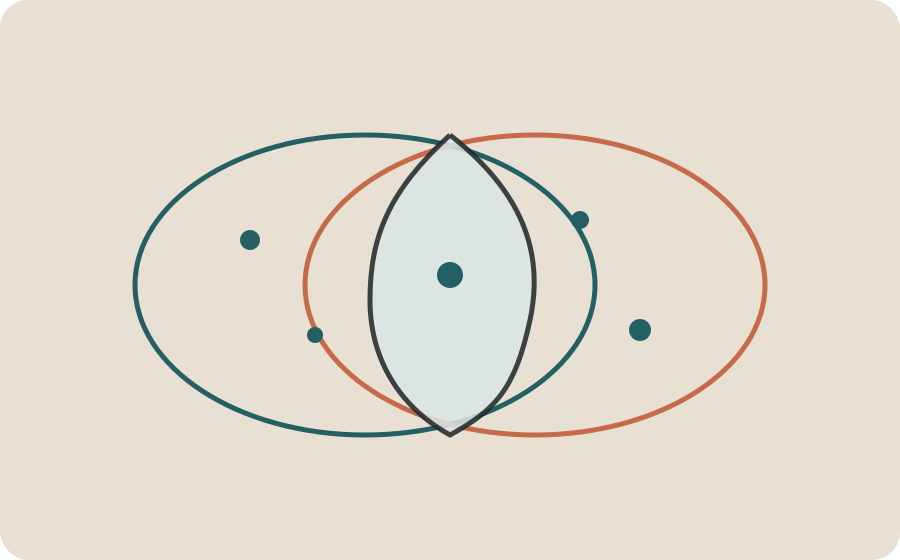
Coverage is a question of overlap and omission.
The AMPD can account for much of the borderline construct while still underrepresenting clinically important themes. The illustration shows overlap without treating overlap as equivalence.
Formal citation
Gilbert, K. J., Manuel, I., Morgan, R. M., Ilagan, G. S., Soroko, E., & Conway, C. C. (2026). The DSM-5 Alternative Model of Personality Disorder's coverage of borderline personality concepts from the clinical literature. Personality and Mental Health.
Coverage, not equivalence
The AMPD captured most—but not all—of the clinical borderline construct.
Across three samples totaling 1,166 participants, Criterion A and Criterion B dimensions accounted for approximately four-fifths of observed variation in self-rated borderline features. Coverage was uneven, with interpersonal instability and self-destructive behavior remaining less fully represented.