Published · Methods article
Powering the Circumplex: A Practical Guide to Sample Size for the Structural Summary Method
The central contribution
Researchers can use principled prospective power analysis when designing studies that estimate interpersonal circumplex profiles.
This methods paper extends the Structural Summary Method from retrospective description to a priori study planning by deriving and validating power functions for amplitude and angular displacement.
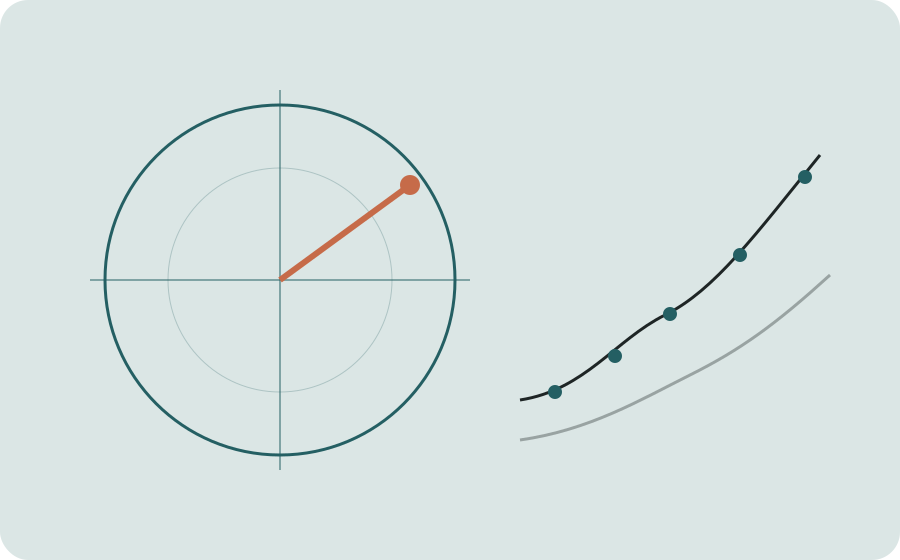
Method in one picture
The geometry of the profile changes the design problem.
Amplitude describes how strongly a profile is differentiated. Angular displacement describes where its peak lies. The precision of a comparison depends on both, which is why the same angular difference can require very different sample sizes.
Interactive methods note
Explore why amplitude and angular separation matter together.
This conceptual calculator demonstrates the prospective two-group approximation described in the paper for 80% power and a two-sided .05 test.
Why the work matters
Three ideas to carry forward.
See the official article for the complete methods and interpretation.
Weak profiles make angles uncertain
When amplitude is low, the estimated peak is less stable and angular comparisons become more demanding.
Effect size is geometric
A difference on a circle cannot be planned as though it were an ordinary linear mean difference.
Prospective planning is possible
Analytical approximations and simulation checks provide a practical route from the research question to a defensible sample size.
Formal citation
Gilbert, K. J. (2026). Powering the circumplex: A practical guide to sample size for the structural summary method. Assessment.